The Home of Global Business Solutions info@ecmgroupza.co.za
Multidisciplinary Project Coordination

Integrated Project Delivery

Bring business, ICT and engineering capabilities together around one brief.

Discuss this service
Service Profile

Keep the Business, Technology and Site Work Moving Together.

When a project involves business, ICT and engineering teams, their plans need to fit together. ECM coordinates responsibilities, milestones and handover so each team can see what it needs from the others.

Equipment may need a prepared site; a system launch may depend on user training. We record these dependencies in a shared plan, assign decision owners and agree how the teams will review readiness. Here, integrated delivery means coordination across disciplines; any contractual delivery model is agreed separately.

Delivery Governance and Handover

  • Discovery, business case, scope and a responsibility matrix (RACI) defining who is responsible, accountable, consulted and informed
  • Coordinated milestones, delivery priorities and tracking of risks, assumptions, issues and dependencies (RAID)
  • Quality reviews, change control, testing and agreed acceptance criteria before handover
  • User training, operating documentation, knowledge transfer and benefits reviews with nominated client owners

The final scope, approach and deliverables are agreed with you before work begins.

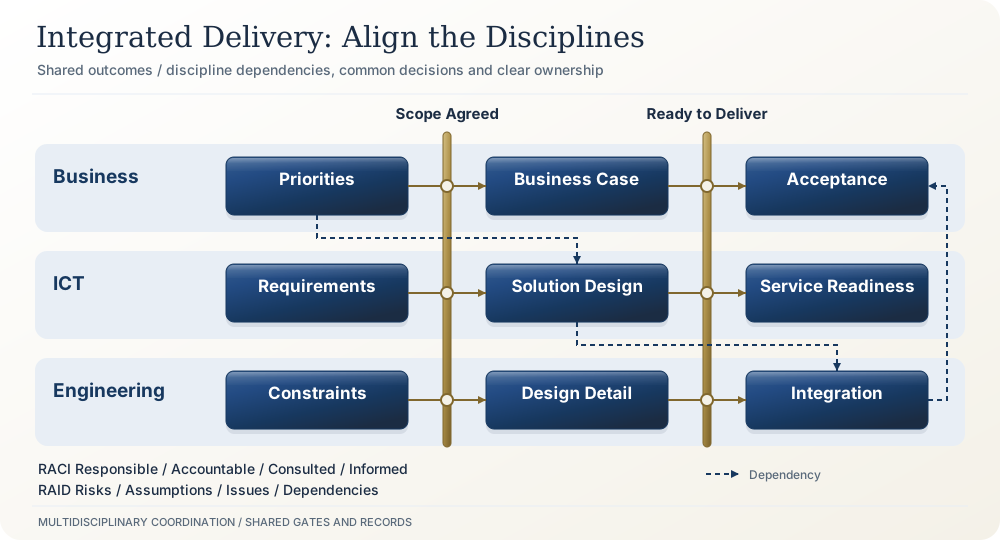
Integrated Delivery: Align the Disciplines

On smaller screens, scroll across the diagram to read each step.

Business, ICT and engineering work in three coordinated lanes, moving from definition through development to delivery. Shared scope and readiness gates span all lanes. Business priorities inform ICT design, ICT interfaces inform engineering integration, and engineering evidence informs business acceptance. A responsibility matrix uses Responsible, Accountable, Consulted and Informed roles. A RAID log tracks risks, assumptions, issues and dependencies. The drawing describes coordination rather than a specific contractual arrangement.
What We Do

Manage the Connections Between the Workstreams.

Define the Result Together

Bring stakeholders around the business need, boundaries and acceptance criteria. Establish what each discipline contributes and how a decision in one area affects the others.

Plan for the Uncertainty

Use a predictive, agile or hybrid approach to suit the work. Known site dependencies may need sequenced milestones, while an evolving application requirement may need short delivery and feedback cycles.

Control Interfaces and Decisions

A responsibility matrix (RACI) clarifies who is responsible, accountable, consulted and informed. Tracking risks, assumptions, issues and dependencies (RAID) gives the team a shared basis for escalation and change control.

Make Handover Part of Delivery

Plan testing, user readiness and operational ownership before the final milestone. Acceptance criteria should cover the result the client needs, including the information and capability to operate it.

The Work Explained

Different Disciplines. One Coordinated Handover.

Agreed Acceptance

  1. Business Readiness

    Process owners, decisions and people prepared for the change.

  2. ICT Readiness

    Applications, data and connections tested for the intended use.

  3. Engineering Readiness

    Site works, equipment and technical interfaces coordinated.

  4. Operational Handover

    Acceptance, documentation and ownership brought together.

The workstreams converge at shared acceptance points. Progress in one discipline does not replace readiness in another.
Potential Outputs

One View of the Work and Its Dependencies.

  • An integrated scope, responsibility map and delivery plan
  • A shared decision, change and dependency record
  • An acceptance and handover pack with operational owners

Outputs are selected to suit the engagement and confirmed in the agreed scope.

Your Next Step

Where Do Your Project Workstreams Meet?

Share the intended outcome, teams involved and the dependencies you need to coordinate.

Contact ECM Group